No longer a silent “D”

Slowly, silently, stealthily it snuck up on me. Going about my day-to-day activities, I had no idea it was approaching and ready to swallow me. Then one day, I couldn’t stop crying. I didn’t know why. I had everything I needed and more. Two beautiful, healthy young children. A wonderful husband who loved me unconditionally. Amazing, supportive, loving family and friends. My health. My home. Life was better than I ever imagined it could be, yet the overwhelming sadness and despair won’t leave.

I tried to fight through it, shake it off, tell myself to smarten up, get over it. I was strong, capable, determined – or at least I used to be… Now I was so tired, spent, useless. But the more I slept, the more exhausted I became. I wanted to be alone. I couldn’t think clearly. I couldn’t focus. The simplest tasks took all my energy. I just didn’t care anymore. I was confused, but above all else – I was really scared. I had no idea what was happening to me.

That was 1995. After confessing my feelings to family, I went for counselling and eventually group therapy for — depression. I hated the “D” word and all that it represented. Beyond a couple of trusted family members, I told no one. I was embarrassed. I was ashamed. Admitting I was depressed made me feel weak. I should have been able to deal with ‘it’ on my own.

My counsellor was kind, understanding, compassionate and made me see otherwise. She had me write down what had happened in my life during the last year. The first 6 months were rather uneventful, but then my mother died. Followed by the deaths of my husband’s grandfather and his great aunt. On the heels of those losses was the birth of our second child, a beautiful baby girl. Shortly after I met my biological father, whom I hadn’t seen since I was 2 years old.

After learning of this chain of events, my counselor replied, “And you’re wondering why you’re struggling?” I responded, “But not everything’s been sad – look at the birth of my daughter and meeting my dad. Other people have so much worse going on in their lives.”

Growing up, no matter what happened, we’d always been told how lucky we were, how so many others were worse off than us, to not complain, to be grateful. Her reply, “That doesn’t take away your right to grieve.”

Grieve? I thought I had done that, but looking back, so much emotion was shoved aside as I ‘got on with it’ and did what needed to be done, or what I perceived was required of me. I didn’t realize that grieving also involved ‘what might have been’ if I my biological father had been part of my life. Postpartum depression was likely also part of the equation although I do not remember it being the focus. It took several months, but eventually I felt healthy, strong and vibrant again. I can’t remember if medication was ever discussed, but for me,  counselling worked. Afterwards I quietly tucked that part of my life away.

It took years before I ever mentioned my depression to anyone, and then only to trusted sources or someone who spoke to me about their struggles. The response 99% of the time was, “You? Depressed? But you’re always so upbeat and happy!”

Actually, not always. And when you live and work on the farm, it is easy to ‘hide’. If you can, you avoid going out in public. When you must go, you quickly learn the best times to avoid seeing too many people. You arrive late and leave early. You find ways to deflect other’s asking, “How are you?”

This past summer, depression came slowly creeping back again. I didn’t recognize it at first. But by late fall, the feelings of overwhelming sadness, fatigue and inability to concentrate seemed all too familiar. I had been avoiding ‘peopling’ whenever possible for fear of tears uncontrollably flowing. I could feel myself spiraling downward but I didn’t want to hit bottom. I didn’t want to return the dark place I was in 1995. I wanted to grab a lifeline. So I did.

I started by being honest with everyone around me. When asked how I was doing (and I knew they genuinely wanted to know), I told them. I made an appointment with my doctor. Without hesitation, he discussed possible solutions including medication and counselling. I chose the latter but knew if I needed more help, it was only a phone call away. I was able to see my counsellor within a couple of weeks. In the meantime I continued on with yoga and bootcamp classes even though being in public was difficult and uncomfortable. I recognized physical activity benefited my mental state. And I walked…and walked. If I accomplished nothing else in a day, I was okay with that. Self-care became priority.

What a difference 22 years has made.

Depression didn’t make me feel weak, ashamed or afraid. I was disappointed to see it overtake me again but was grateful I recognized it. I knew how to reach for help and it wasn’t hard to find. And I realized that being honest and open doesn’t make us vulnerable, it just makes us human.


Need help or someone to talk to? Consulting with your healthcare provider or another trusted professional is always a great start.  Click on the links below for lists of places to call, text or chat across the country. 

Manitoba Farm, Rural & Northern Support Services 1-866-367-3276

Farm Stress Line – Saskatchewan 1-800-667-4442

Alberta Health Services 1-877-303-2642

Canadian Crisis Centres

Crisis Services Canada 1-833-456-4566

Bell Let’s Talk 

Mental Health in Farm Language 


World Soil Day

Man, despite his artistic pretensions, his sophistication and his many accomplishments, owes his existence to a 6-inch layer of topsoil and the fact that it rains. – Anonymous


Surveying a wheat field which has had the straw incorporated back into the soil after harvest.

World Soil Day is held annually on December 5th to focus attention on the importance of healthy soil and advocate for sustainable management practices.  With all the food grown to feed the world produced on only 1/32nd of the planet, it’s easy to understand why our land resources deserve recognition.

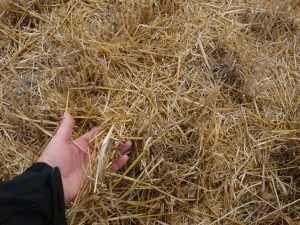
Straw left behind after wheat harvest to be tilled back into the soil to add organic matter.

As farmers, this awareness is second nature and we continually strive for sustainability of this finite resource. Caring for our soils is crucial and the key to our viability as well as those who will farm our land in the future. Incorporating organic matter back into the soil and minimal tillage are an integral part of our farm’s management to obtain optimal soil health and structure. Reducing soil erosion and loss of nutrients are priorities.

Summerfallow used to be a commonplace practice on the prairies, and on our farm. But over time, it was learned long-term use of summerfallow actually degraded soil quality and was not sustainable, so the practice was discontinued.

Soil scientists, agronomists and farmers work together to create and keep our soils healthy. Soil testing, field mapping and GPS technology create maps and ‘prescriptions’ for fertilizer, ensuring it is being applied efficiently and only in amounts needed. Less tillage and efficient placement of fertilizer means less use of resources and a reduction in greenhouse gas emissions.

Education is ongoing and when we know better, we do better. Farmers have a deep connection to the land and the environment. Our workplace is also our home. The love of the our environment and growing food runs deep. We will continue to be stewards of the land and do our very best to care for the soil that sustains us all.


Soil Facts from The Food and Agriculture Organization (FAO)

  • 95% of food is produced on our soils
  • There are more living organisms in a tablespoon of soil than there are people on earth
  • It can take up to 1000 years to form 1 centimeter of top soil
  • Most of the well-known antibiotics originated from soil bacteria, including penicillin
  • Healthy soils with a high organic matter content can store large amounts of water
  • More than 10 million people have abandoned their homelands due to drought, soil erosion, desertification and deforestation.

When the sun called…

“I cannot endure to waste anything so precious as the autumnal sunshine by staying in the house.” — Nathaniel Hawthorne


“There is a muscular energy in sunlight corresponding to the spiritual energy of the wind.” — Annie Dillard

Winter arrived just before Halloween in Manitoba this year. But in 2016, fall lingered long into November before giving way to the cold and snow. Photo memories  of November 26th took me back to that incredibly gorgeous day when the sun called.

Cloud-cover had reigned for over a week and I was in sunshine withdrawal. So as I sat having my Saturday morning coffee, watching the sky brighten to the east through the trees, I knew my plans for the day would change. Even my second cup of coffee would have to wait.

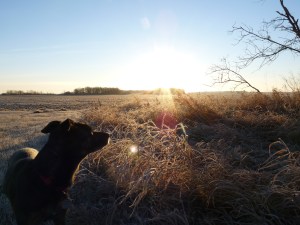
I didn’t hesitate to set aside my long ‘to-do’ list. The dog and I headed out into the crisp, quiet morning air and walked to the end of our lane to catch those first beautiful rays of sun. This day was meant to be embraced and enjoyed — outside, not in the house.
“The poetry of the earth is never dead.” – John Keats


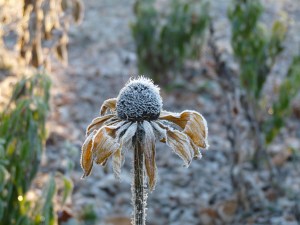
As we strolled though the yard, I was reminded why I am always reluctant to pull out my flowers once they are past their prime. Their beauty evolves with an elegant melancholy as the growing season draws to an end.


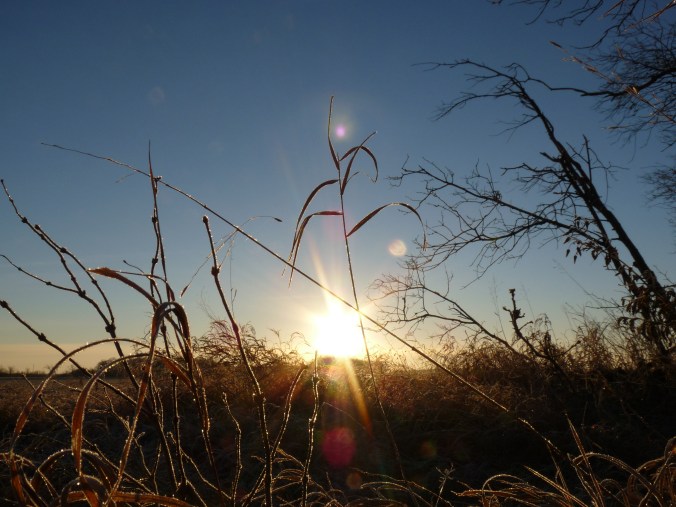
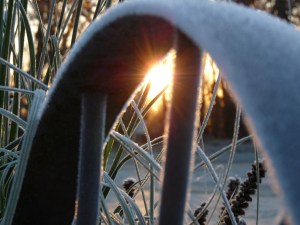
Everything glistened and seemed to come to life as the morning sun glinted off the light dusting of frost which had ‘painted’ the landscape overnight.


But as the temperature rose, the frost dissipated. The winds were calm and the sky oh so blue! Country roads were calling and I wasn’t about to decline the offer of taking in the beauty right out my backdoor.


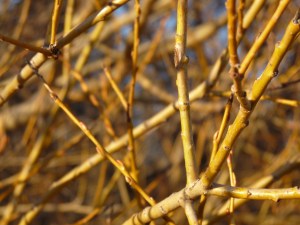
Willow branches were vibrant against the bright blue sky.

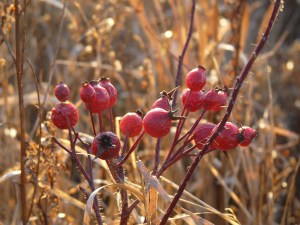
Wild rosehips added a punch of colour in the ditches.

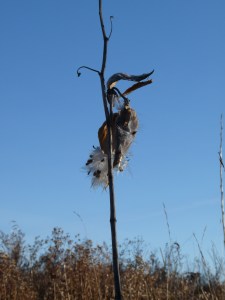
Nature’s art is everywhere! A milkweed seed-head looking rather duck-like!

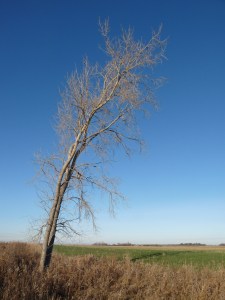
Who doesn’t love a lone tree in the middle of the prairie?


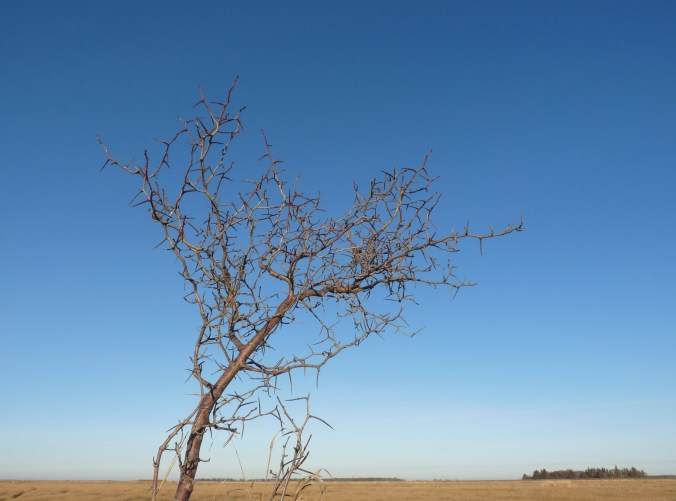
A lone Hawthorne tree on the edge of our old cattle pasture. Can you tell the prevailing winds are from the west? And is it just me or does the outline of the branches appear to form a heart?

‘Hay’, check out that sky!

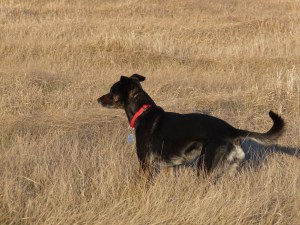
My trusty side-kick, game to wander through the old pasture.

Sunset through the trees along our lane.

That sunny Saturday ended up being our final farewell to fall last year.  A balmy, unseasonal +8 Celsius day that ended as striking and beautiful as it started.  A day I’m grateful I stopped to enjoy.  A day which reminds me to always listen when the sun calls…


Outdoor Treadmill

Outdoor Treadmill

No fees, set hours, restraints on time — 
my outdoor treadmill suits me fine .  

Prairie snow provides vast retreat,
 with snowshoes strapped beneath my feet.

Crunching of snow the only sound
as I walk atop frozen ground.

Crisp, cold air upon my face
heightens senses, worries – erased.

Bright sun reflecting on the snow
gives icy crystals sparkling glow.

Deer, rabbits, fox may happen by,  
or owl glide across the sky.

All of  this,  just out my door –
nature’s gym, yet so much more…

Grateful to have waiting for me,
such splendor and tranquility.

Sandi Knight © 2007

Building Community – One Bag of Potatoes at a Time

Mark & Yanara Peters – Certified Seed Potato Growers

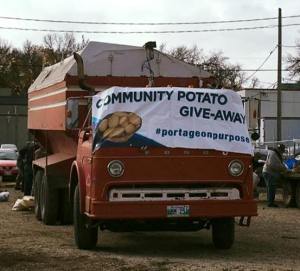
Is it possible to give away 35,000 lbs of potatoes in just under 5 hours? Why yes,      it is.  And growers, Mark and Yanara Peters were thrilled to make it a reality.  On October 14 they hauled in their potato trucks and a conveyor, from their farm 12 miles northwest of Portage la Prairie, and made it happen.


  Despite the cool Saturday morning, people were already lined up by 8:30 – a half hour before the Portage Community Potato Give-Away was slated to start. They came pushing strollers, riding bikes, walking and  on scooters, as well as by car and truck. Many heard about the event on local media or on-line, while others just happened by and wondered what all the fuss was about.
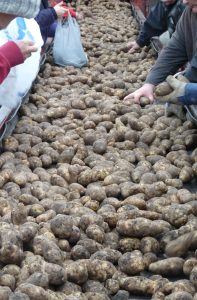
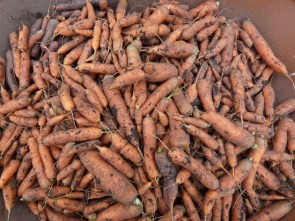
Well, the ‘fuss’ was about sharing a bountiful crop, building community, listening and sharing stories. It would be much simpler to take produce directly to a food bank or soup kitchen to distribute, but last fall at their first community give-away, the Peters discovered the magic in the one-on-one interaction. They don’t consider or mention the effort, time or cost that this intentional act of giving requires.  But they do remember and appreciate how generous people were with them as young adults and simply want to pay it forward.

Gathering spuds along the 36-foot conveyor

With the help of a few volunteers, people gathered around the conveyor – some approaching cautiously, unsure of what to do and/or in disbelief that could they take as many potatoes as they needed. As bags and boxes were filled, they opened up about their lives, and those of others whom they were helping. Grandmothers spoke of the after-school meals they make in their homes for children in their community. They are not only nourishing bodies, but souls and passing on their cooking skills to another generation.


Those who live alone took small bags for themselves, but many knew of families in need or shut-ins who would also appreciate the farm-fresh produce. Immigrants spoke of the gratitude they have for living in Canada and the joy in being reunited family members as they arrive. Some people were there to collect potatoes for perogy fundraisers or church dinners — supporting other needs in the community.

Food memories were shared — how family-favourite soups were made, preferred methods for cooking up spuds, whether it be fried, mashed or baked, which spices they like to use and if butter or gravy was the best. One young mom was taking the potatoes home to make Irish Potato Bread. She described how her grandmother, now living in a care home, had taught her to make it — her pride in carrying on tradition was evident.

Those who had excess garden produce — tomatoes, beets, carrots — brought it by to share with the crowd. Others dropped off bags and boxes to ensure those who didn’t have containers had something to cart their potatoes home in. One young family stopped by to get their spuds, then stayed to help others gather theirs.
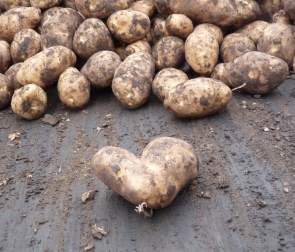
Inadvertently, the event also offered an opportunity to agvocate (advocate for agriculture) and engage in farm to food discussions. The young ones in the crowd often opened up the best conversations. “Why are the potatoes dirty?” “How come there are so many different shapes and sizes” “Why are you giving them away?”        So discussions ensued on food waste, what happens to produce before you find it on your store shelves, and why it feels good to give back when you can.
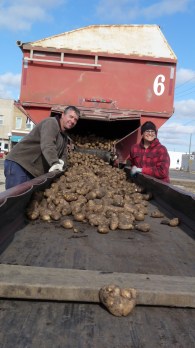
Mark & Yanara Peters pausing for a photo as their Community Potato Give-Away drew to a close.

After last year’s giveaway, there was no doubt in the Peters’ minds that if given a successful crop, they would share again. This year, my husband and I were fortunate to be able to help and found out first-hand just why. Besides the stories, memories and agvocating, the gratitude expressed by those who came by was truly heart-warming. While some merely thanked you with a shy smile, others wanted to shake the farmer’s hand. Coffee and snacks were dropped off. One gentleman pressed a few coins into Peters hand, insisting he buy himself a coffee despite Peters repeating it was not necessary.

But the most touching moment for me was a grandmother, who put her hand on her heart,              looked Mark in the eye and expressed her deep appreciation, saying, “You don’t know what this means to us.” Then she reached across the conveyor and embraced Yanara in a hug.

If you’re going to build community, this is way to do it, face-to-face and heart-to-heart.

Agvocating through art

Originally published in the July 13, 2017  issue of the Manitoba Cooperator


As farmers we don’t often have the opportunity to celebrate and showcase the crops we grow. So, when the opportunity arises, why not take it?

Earlier this year, our local arts centre asked for exhibit ideas for their boardroom gallery. Considering 2017 is canola’s 50th anniversary, I suggested a display of pictures, products and facts to celebrate. It was built around a blog post from last July entitled, Simply Canola, and inspired by the Canadian Agriculture and Food Museum in Ottawa. The museum is commemorating Canada’s 150th birthday and Canola’s 50th anniversary with a nation-wide travelling exhibition, “Canola: A Canadian Story of Innovation” as well as an on-site exhibit, “Canola! Seeds of Innovation.”

Leanne Campbell photo

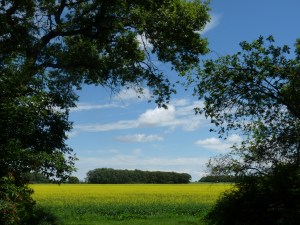
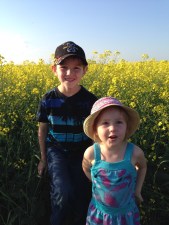
By far, canola is one of the most recognized crops we grow. There is no doubt it is the shining star of agriculture across western Canada every summer when it blooms. It isn’t unusual to see people stopping alongside the road to snap a picture, or take a ‘selfie’ against its gorgeous sea of yellow. Even those of us who grow it, are taken in by the allure of those bright and beautiful blossoms. Case in point – my extensive collection of photos from 2016.

With less than two percent of Canadians living on farms, there is a huge disconnect between food producers and consumers. Surveys show consumers want to learn more. We’ve been advised to tell our story, our way. So why not tell it through art? Especially when you can celebrate a crop many people are familiar with on a visual level.

Simply Canola is a pictorial diary of the canola we grew on our farm last year. Twenty-six photos, displayed in date order, give a tour from emergence to harvest, from close-ups to landscapes to sunsets. I’m hoping they convey the pride we take in growing this iconic prairie crop. A display case with canola, a sample of products made from it and bright yellow note cards with canola facts add an element of education to the display.

Jennifer Dyck photo

Canola is so much more than a pretty backdrop on the prairie landscape under the summer sun. The impact it has had in Canada and around the world in just 50 years is astounding. As the world’s only “Made in Canada” crop, I’m pleased to have the opportunity to agvocate and celebrate it with my photography in our local community. To date feedback has been positive and encouraging, both from consumers and those in the ag industry.

If you are in Portage la Prairie, please stop by and enjoy our farm’s views and vistas of Simply Canola. The exhibit is on display at the Portage and Districts Centre (11 2 St NE, Portage la Prairie, MB) from June 20th – August 5th in the Boardroom.

Gallery Hours: Tuesday to Saturday, 11:00am to 5:00pm     Click here for directions.      (Note: Boardroom Gallery closed Wednesdays 12:30pm-3:30pm)  


Comments on “Simply Canola” 

“Who knew? Well done!”

“Beautiful, picturesque and educational.”

“Thank you – for this great contribution to the industry.”

“Excellent way to capture beauty and education.”

“I learned so much about canola!”

“Beautiful memories of home.”

“Lovely…and educational.”

Show. Share. Connect.

2016-07-05-13-09-39

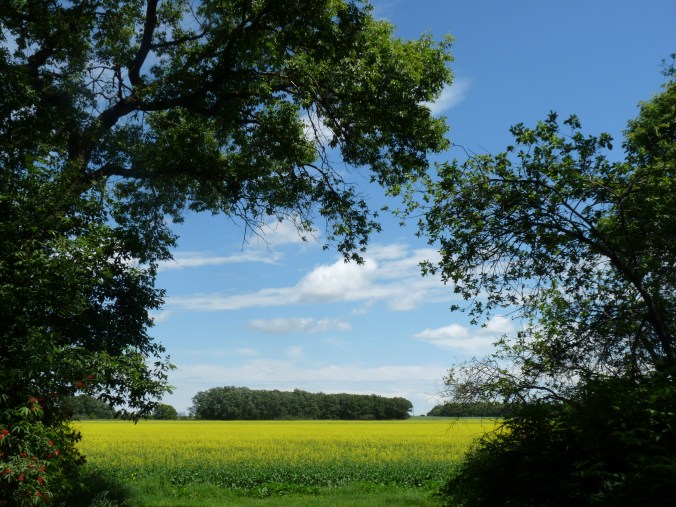
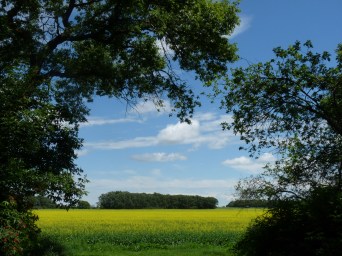
Canola in bloom east of our farmyard

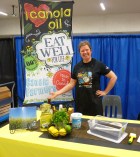
Recently I had the opportunity to host the Manitoba Canola Growers booth at an Ag Awareness Expo. Not having done this before, I was a little nervous. But I was advised to, “Be you. Be authentic. Listen for common ground.”

16387155_1362550283795226_3062305095032048118_n

“It’s what in the inside that counts”

As people stopped by, conversations began to flow and it wasn’t long before nervousness transformed into enjoyment and ultimately, gratitude.  Parents watched and listened as their children exuberantly ‘crushed canola’ and saw for themselves how it’s possible for those tiny black seeds to make clear yellow canola oil.

16508794_1362550460461875_1897038152523407215_n

“Shaken not stirred”

Youngsters and adults alike enjoyed picking out ingredients to create and customize salad dressing following the simple 2:1:1 ratio – 2 parts canola oil, 1 part acid (vinegar or citrus), 1 part emulsifier (mustard or honey), adding herbs if they wanted to kick the flavour up a notch.

These hands-on activities led to a variety of discussions on food and farming:

  1.   p1170714The patience a farmer needs to wait for the canola to ripen.
  2.  Bees – how they love canola and so many of us love honey.
  3. Half your Plate– how kids custom-creating their own dressings can lead to trying and consuming more salads and veggies.
  4. Canola meal – how the ‘leftovers’ after the oil are crushed and used in livestock feed, and help dairy cows produce more milk.
  5. Baking and cooking – using canola oil to make cakes, cookies, fries or even grilled-cheese.
  6. Ag in the Classroom – some students had done one or both of our activities at their school though AITC but were either anxious to repeat and/or encourage their sibling or parent to do the same.
  7. The variety of Made-In-Manitoba products and booths around us – using honey, jam or beet juice in a dressing. How quinoa can be used instead of greens for a salad and how lucky we are to have so many prairie fruits to add to flavour to our salads in the summer.

ag-expo-portageThe majority who stopped by were genuinely interested in conversation, with many sharing how they use canola oil in their kitchens. This gave me the opportunity to say, “Thank you,” and, “As a canola grower, I appreciate you using a product we grow on our farm.” Something happened in this moment.  A connection was made. Many did a double take, perhaps surprised. When our crops are sold directly to a grain company or processor, there is no contact with the end-user. I’m not sure I’ve ever had the opportunity to directly thank a consumer, but it felt good.

While hosting this booth was a little out of my comfort zone, I’m glad I accepted the opportunity to show, share and connect. It was enjoyable, gratifying and a reminder to express thanks whenever the opportunity presents itself. While I truly value the sentiment behind “Thank a farmer”, appreciation should flow both ways.

So whether you’re a home cook, chef, baker, dietitian or home economist who chooses canola oil, from our farm to your kitchen – thank you.

2016-06-30-20-29-34

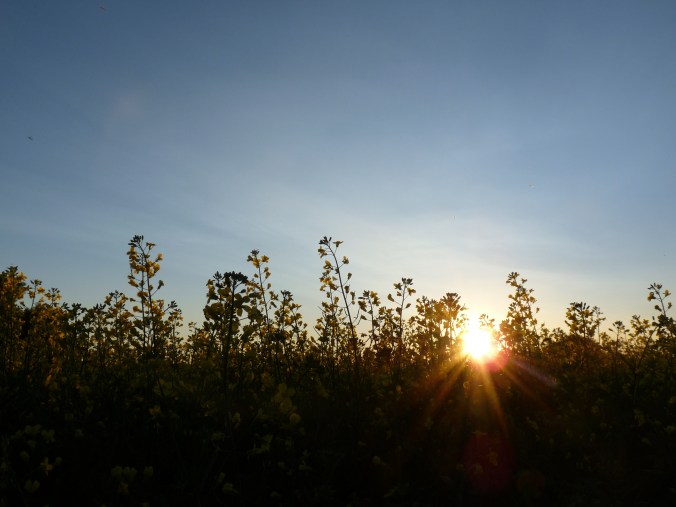
Canola field at sunset

Agvocating – Where do I begin?

Originally published in the November 2016 issue of Canola Digest 


With less than two percent of Canadians living on farms, there is a huge disconnect between food producers and consumers. Surveys show consumers want to learn more. In order to give them credible information, farmers and others in the ag industry need to speak up. Advice and workshops on advocating for agriculture, or ‘agvocating’, has been presented at many farm shows/conferences over the last year.

kevin-folta

CAST photo

Dr. Kevin Folta  is a professor, Chair of the Horticultural Sciences Department at the University of Florida and winner of the 2016 Borlaug CAST Communication Award. “Recipients of CAST’s annual award are science/ag experts who demonstrate an ability to communicate through written material, public presentations, and various forms of media.” Folta does it all, and  does it exceptionally well. He speaks across North America and has a strong on-line presence. He offers this advice when discussing agricultural biotechnology with a concerned public.


DO:

  • Start with shared values and common concerns. “Like you, I want my kids to eat healthy food.”  “My family lives on the farm. I care about the farm environment. Here’s what I do…”
  •  Have honest conversations about what you know; speak to your strengths.  If you don’t believe it, don’t say it.
  • Disengage when attacks become personal, it is unproductive to continue.
  • Talk about ethics, your experience and your priorities. Remember you cannot fight fear with facts.
  • Sign up for social media accounts – Twitter, Instagram, Facebook. Follow other agvocates. Even if you don’t create content, you can have a tremendous impact by amplifying others’ messages. ie. share good work, making it more visible.  Signing up also ensures that you have control of your own name.

Don’t:

  •  Use the “feed the world” rhetoric.
  •  Dodge discussions on the limitations of genetic engineering/modification (GM). See Folta’s slide deck for more.
  • Ever claim GM is a single solution. It is not.
  • Discount other production methods or tools. All tools are needed going forward.
  • Discredit other forms of genetic improvement  such as mutagenesis.

Take-A-Way:

We have the safest, most diverse and abundant food supply in history. We also have immediate access to information — good and bad. If we engage incorrectly, we make the  broken lines of communication between consumers, scientists and farmers  worse.

To change the hearts and minds of a concerned public, we need to get involved in the conversation — in person, on-line or both. According to studies farmers are both warm and competent, so sharing our stories is critical to ensure and maintain access to ag innovation for everyone.

p1160076So begin with telling your story, your way. Don’t get bogged down in the science and terminology. Explain how precision plant breeding benefits your farm, the environment and food production.

Read, watch videos, listen to podcasts, learn from others, share their stories and practice telling yours. Remember if you don’t have the answer to someone’s question, it is okay to say, “I’ll look into that and get back to you.” Add your voice to the conversation — everyone’s is needed. If we don’t tell our stories, who will?


Kevin Folta resources:

Other Ag resources:

Weathering the Rain

Originally published in the Manitoba Cooperator October 6, 2016 

Reflections on the seemingly endless rains this past growing season. For many across western Canada, snow was added to the mix in early October and harvest continues to be an ongoing challenge for far too farmers.  Thinking of those who are struggling to get their crops from the field to bin and hoping everyone will soon be done with #Harvest16.  


facebook_1474855006708I used to be that girl, the one who would joyfully head outside when it rained. I loved everything about it. The rhythmic sound on rooftops. The patterns it made as it rolled down windows. The feel of rain on my cheeks. The way it would it soak through and soften my wild, curly hair. If the rain was coming down fast and furious, I was content to sit under the cover of the front porch and watch. But the best rains were gentle, light, perfect for walking. The air so fresh, the streets quiet and still. Those rains offered a refuge from troubles and worries. I can still see my younger self soaking in the peace and serenity of those walks.
Yet there I sat, staring at the computer screen, tears instead of raindrops, slowly rolling down my cheeks. A friend was embracing and enjoying that night’s rain. Her post on social media read, “Jammies, slippers, hoodie, book, veranda, rain! Wonderful combination. .oh yes..glass of wine.”  She was doing exactly what I believe in and strive for — embracing the moment. But instead of being happy for her, I was jealous. Not of what she had, or what she was doing, but of that feeling, that freedom, that joyful connection to the rain.

I had the comfy clothes, books and wine, maybe not the veranda to relax in; that wasn’t the issue. What really got to me was the fact that she was enjoying the rain — and I wasn’t. In fact, after almost 3 months of excessive rains, I was cursing yet another downpour that was downgrading our wheat and delaying the start of harvest.

You would think after 27 years of farming, I would be used to it, but that night the dismal weather really weighed me down. I missed being that girl and my past laissez-faire relationship with the weather.

When your income is dependent on Mother Nature, your relationship with the sun and rain becomes fickle.  Excess amounts of either, especially at critical times during the growing season, can cause anything but joy and relaxation. The hold the weather has on our lives, can at times, be tiring.

I’m rather embarrassed by my feelings that night; jealousy is not an admirable trait. And being jealous of a feeling — well, that borders on absurd. I confessed to my friend. She totally understood, but we agreed the next time that happens, I am to join her.

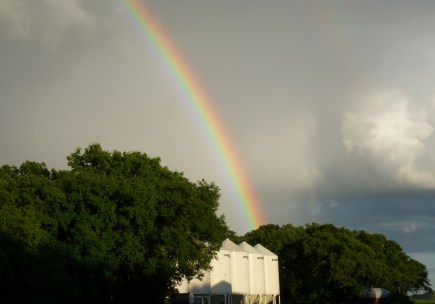
rainbowI spoke to another woman, who has long since retired from farming and asked her if concern for the weather ever goes away. She laughed, “No.” So I guess I’ll have to be content with my memories of that girl. Look back on her fondly and smile. Even when we no longer work the land, concern for farmers will always be there, and I will be that little old lady who politely asks, “So, was that a good rain?”


It helps to talk to someone who listens and understands. No matter the issue, you can contact the Manitoba Farm, Rural & Northern Support Services. They offer free, confidential information and non-judgmental support, for anyone who lives on farm, rural or northern community. Call Toll-Free 1-866-367-3276 Monday – Friday 10 a.m. to 9 p.m. After hours 1-888-322-3016

A list of nationwide resources in Canada can be found here


From My Corner of the Prairies – Canada In A Day

September 10, 2016 was Canada In A Day. We were asked to film our lives — whether it be a special occasion or a simple moment. The resulting video compilation will be used to celebrate Canada’s 150th Birthday next July.

Instead of a film, my story is one of pictures, reflections and simple gratitude for being a Canadian who has the privilege of living and farming on the vast and beautiful prairies.

Life is made great by the million little things that piece together our days and weave into their way into the tapestry of our lives.

Here are the pieces which made #CanadaInADay special to me.

Waking up to the smell of freshly brewed coffee, pouring a cup and enjoying this view.


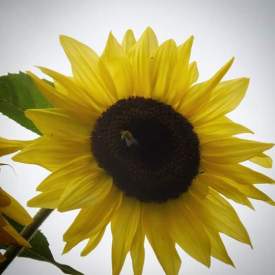
Wandering through my yard, taking time to notice the little things, like the bees enjoying my sunflowers.

Wandering through my yard, taking time to notice the little things, like bees on the towering sunflowers in my garden. 


p1120655

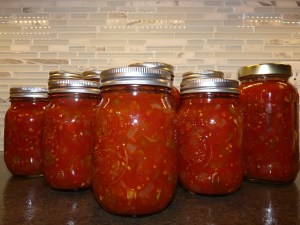
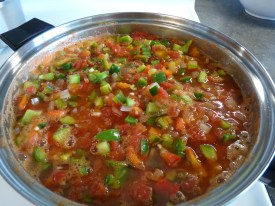
The satisfying job of chopping garden-fresh tomatoes, peppers, onions and celery, followed by aroma of simmering salsa wafting through the kitchen .

p1080437

Listening to the consistent ‘snapping’ on the jars of the finished product, knowing they are properly sealed and preserved for the months ahead.

facebook_1473569210893

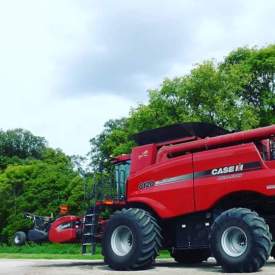
Having the combine come out of the shed to finally resume harvest after a week of rainy weather.

facebook_1473569225387

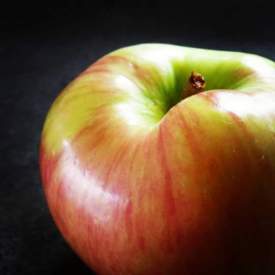
Enjoying the delicious, fresh, crisp crunch of a B.C. Honey Crisp apple for a snack.


facebook_1473569195954

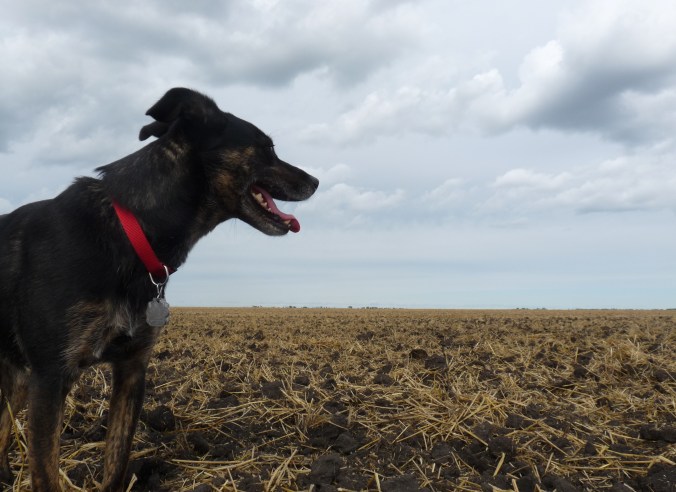
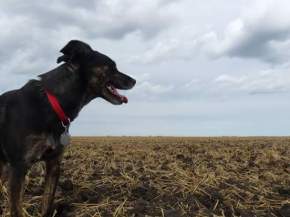
A leisurely afternoon walk with our dog.  She stopped briefly by this freshly cultivated wheat field.  We work the straw into the soil to improve organic matter and soil health. 

facebook_1473569178708

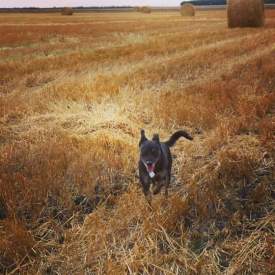
“Pure joy! ” Watching my  trusty side-kick , having a blast running through a wheat field. Here the straw has been baled to be used as bedding for cattle this winter.


p1160941

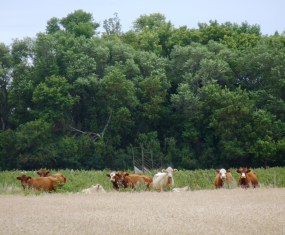
Appreciating that I can walk for miles on quiet country back roads without seeing a soul.  It doesn’t  necessarily mean my presence isn’t noticed though…The dog and I obviously piqued the interest of the neighbour’s cattle!

2016-09-05-15-19-00

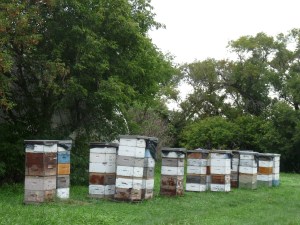
Seeing these hives is a reminder that a delivery of fresh honey will soon arrive at our door.  A fellow farmer keeps bees in the shelter of an old yard-site on our farmland. The bees love the canola and alfalfa we grow, and we love the honey they produce!


facebook_1473569165592

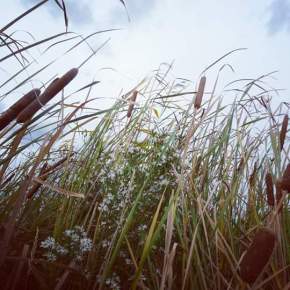
Walking to the marsh that borders part of our farm and capturing the beauty of the bulrushes and wildflowers blowing in the wind.  The marsh provides a unique and diverse ecosystem for a wide variety of plants, animals and birds.

facebook_1473569151427

Riding alongside my husband in the combine, enjoying his company and the view as he harvests a field of canola.

p1170059

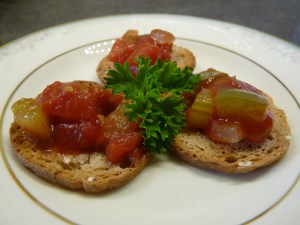
Taste-testing the fresh-made salsa for an appetizer. So good!

facebook_1473569135925

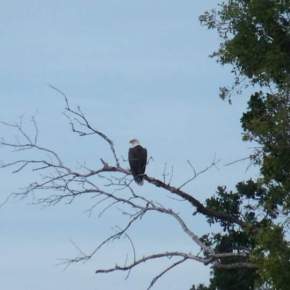
Watching this bald eagle overlook the field we were harvesting. They aren’t usually this close to our yard, but hunting was easy as rodents scurried away as the canola swaths were picked up.

facebook_1473569111253

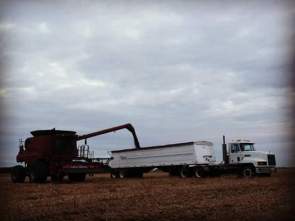
Being thankful for a south wind that kept the moisture at bay as clouds rolled in later in the day.  Once the grass is wet with dew in the evening, it often makes the crops too ‘tough’ to harvest. Here the combine is unloading canola onto a grain truck so it can be hauled to our farmyard and put in a storage bin.

2016-09-10-19-04-58

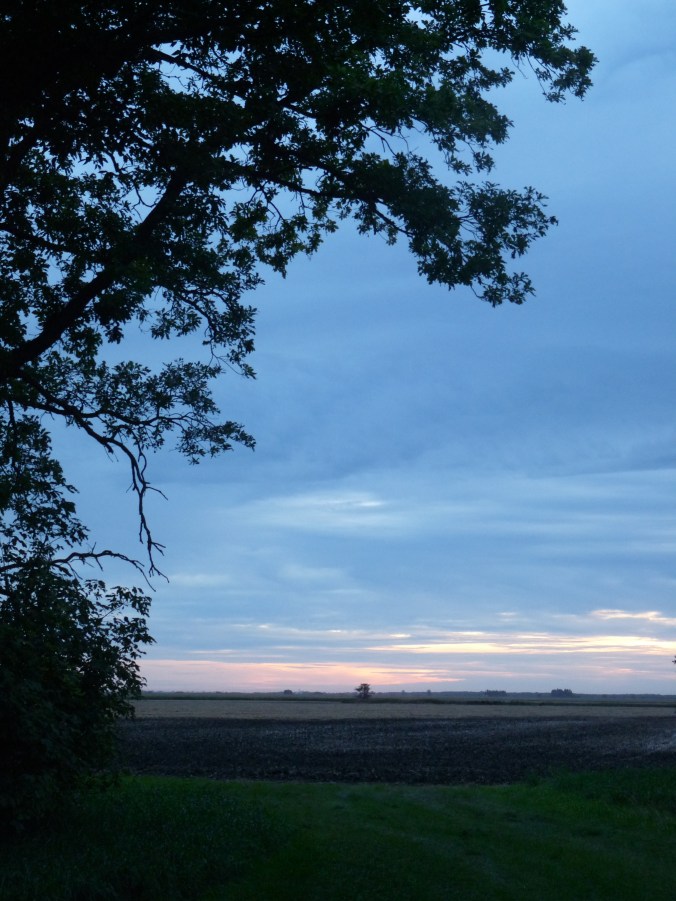
Taking the time to savour this view at the end of our farmyard as the sun set. The end my tribute to #CanadaInAday.