Originally published in the March 2015 Canola Digest
Agriculture and food production are in the spotlight now more than ever and GMOs are on the hot seat. But the science is often misunderstood.
Dr. Kevin Folta, horticulture professor and research scientist from the University of Florida, spoke about communicating science at the Manitoba Canola Growers Association’s “Does science belong on my plate?” event in Winnipeg in October.

Kevin Folta – photo by Tyler Jones.
Speaking to home economists, dietitians, students, food bloggers, consumers, farmers and industry members, Folta broke down the science, dispelled myths and alleviated any fears one might have had over how our food is produced.
He began by addressing the trepidation consumers have of genetically-modified organisms (GMOs) despite not knowing exactly what they are or how they work. He asked the group if they knew how many crops currently use this technology. The answer in October was eight — corn, canola, soybeans, cotton, alfalfa, papaya, sugar beets and squash. FDA approval of Simplot’s Innate potatoes in November 2014 makes nine.
Folta explained that “transgenic”, rather than GMO, is a more accurate description, meaning plants contain a gene inserted using recombinant DNA technology. This is a precise extension of conventional plant breeding but changes only one to 3 genes instead of 10,000 to 800,000 that can change through conventional breeding. And it takes less than 5 years to develop as opposed to 5-30 years through conventional breeding.
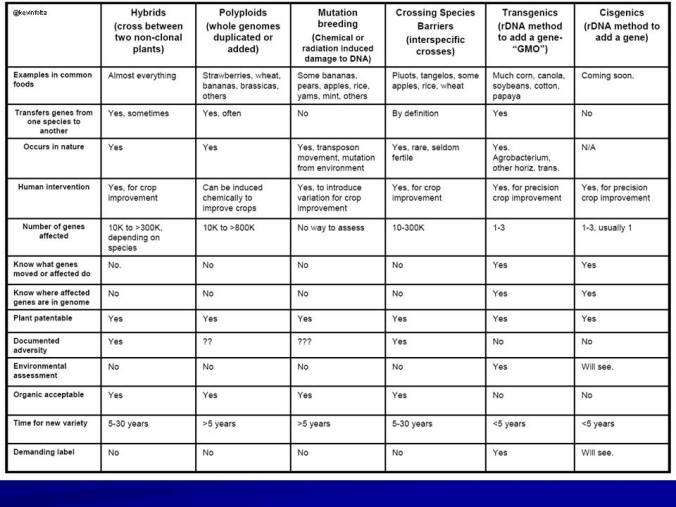
Plant Breeding Chart – courtesy Kevin Folta
He described how genes are transferred. It is a straightforward and effective process, not resembling at all the “frankenfood” images often seen on the Internet. And it is tested and safe. In 18 years, not one case of illness or death has been related to GMOs.
While the technology may be relatively new, he reminded us that humans have been manipulating plant genetics for more than 10,000 years. As the world’s population increases, moving forward in developing genetics and production methods will generate better quality and increased yields on the same land-base with fewer inputs. Resistance is one limitation, but this can be overcome.
Many consumers want “natural” food, but Folta advised that nothing we eat is natural. It has all changed from its original form.
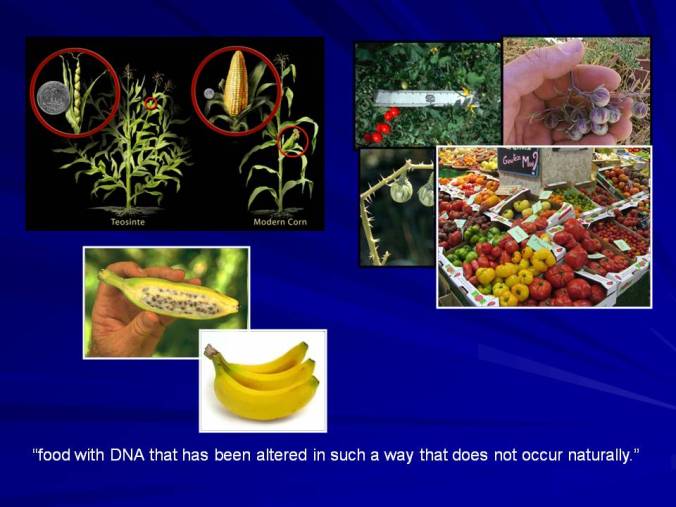
Courtesy Kevin Folta
The public is hungry for knowledge, but torn as to who to believe. Fear and risk are being manufactured and sold by so-called experts, he says. Correlation, not causation is being cited. Biotechnology is only part of the solution in feeding our growing world, but it shouldn’t be opposed for invalid reasons.
The most sobering part of his presentation was learning of available solutions being blocked because of misinformation, fear and activism.
Strawberries could be grown without fungicides by allowing a single gene within the strawberry to be “turned up” all the way, he says. Biotech “golden” rice, rich in Vitamin A, could prevent blindness and death. Root disease could be stopped in cassava, a nutrient rich root vegetable. Drought-resistant corn could be grown. The allergy gene in peanuts could be “turned off”. Black spot and wilt could be prevented in tomatoes. Oil content and quality improvements could be made in soybeans and canola. Diseases could be stopped in grapes, eggplant and citrus crops.
While this technology sits on a shelf, the benefits to farmers, consumers and the environment are being delayed. Most striking are solutions to drought, famine and disease in developing nations not being implemented because of activism from first world countries where food is abundant, plentiful, affordable and safe.
As a farmer, I believe if all concerned consumers had the benefit of attending this informative event, the debate over how our food is produced would stop. The evening was invaluable as a resource for advocacy. If we and others in the industry are able to share our stories and answer questions, perhaps we can help advance science and reason to ensure productive steps continue to taken to improve agriculture methods and food production around the world.
More information on GMOs can be found via the links below.
GMO Answers
Talking Biotech Podcast
Biofortified Blog
Genetic Literacy Project

















































 Sandi Knight