Originally published in the Manitoba Co-operator March 14, 2019

Stewart Akerley by his Little Green Thumbs classroom garden at LaVeryndre School in Portage la Praire, MB
From the moment you step into his classroom, Stewart Akerley’s unbridled energy, passion and enthusiasm for teaching is evident.
My husband and I first met this Portage la Prairie School Division elementary teacher when we volunteered for Canadian Agriculture Literacy Month (CALM) in March 2015.
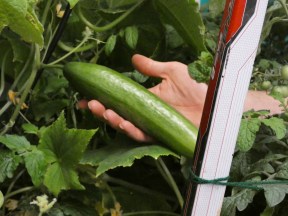
Cucumber almost ready for harvest
It was also Akerley’s first year of participating in Agriculture in the Classroom’s (AITC) Little Green Thumbs (LGT) program which provides teachers with everything they need for an indoor garden. It compliments the curriculum at any level and offers students the opportunity to grow their own food (tomatoes, cucumbers, beans, peas, lettuce, herbs) right in their classroom, giving them a valuable hands-on learning experience.
Mr. A’, as he is affectionately known by his students, found out about AITC and their Little Green Thumbs program from another teacher in the division.
“She was discussing the success she was having growing a garden in her classroom and I was hooked on every word. I filled out the online application to AITC that very same day,” Akerley said.
During his first year in the program, I asked if he was a gardener. Surprisingly he wasn’t. “I’m learning along with the kids!” he enthusiastically replied. He set up his garden and jumped into learning with his students.
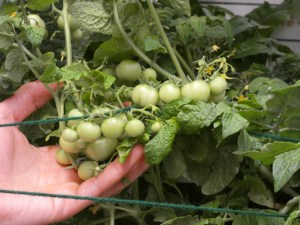
Cherry tomatoes in progress. Mr. A’s current record for cherry tomatoes grown in one year is 500. He’s hoping to break that record this year!
The outcomes were very fulfilling. “As a teacher, I love to see kids engaging with live plants and learning how to care for them. I love to see their enthusiasm as they get rewarded with healthy food for all their hard work. Gardens offer a wealth of learning for young minds and I will always have one in my classroom now. The challenges have been few. We’ve had a few bugs (insects); holidays make it tricky to keep the plants watered and once the plants are ready for harvest, it’s hard to keep little fingers off. That last one’s a good challenge, though.”
Akerley strikes you as one of those people who was born to teach, but the path to it wasn’t a direct one.
“I started out my career managing automobile collision repair centres and did this for six years. During this time I was asked by my church to try teaching Sunday school. For me, it was an instant hit. While my career was stressful and draining, teaching once a week poured life and vitality back into me. I knew I had to pursue this further. Within a few months, I had quit my job and was accepted into Education at University of Winnipeg. I am now in my eleventh year of teaching and have had the pleasure of teaching in six different schools.”
Akerley also believes in taking opportunities to expand learning outside the classroom. He has run both floor and ice hockey programs for students and is an ardent advocate for healthy eating. At the end of the school year, sending home plants for his students to care for during the summer months has become routine.
During his third year of having a classroom garden he added to the program by purchasing a Tower Garden (an aeroponic systems using water, liquid nutrients and a soil-less growing medium). Successful application for a bursary provided the funding. The vision was to have healthy food more visible and available to students throughout the school. The results were remarkable.
“By the end of the first year with the tower garden, we had produced three different types of lettuce, rainbow chard, arugula, red peppers, cherry tomatoes and strawberries. From it we were able to have three ‘salad parties’ throughout the year that fed 20-30 people each time.”
Feedback like this has made it all worthwhile. “Mr. A, my family went out for supper last night and I ordered salad because the salad we had at school was so good,” one student commented.
Akerley emphasized, “This is what I want my students to take away from this experience. I want them to know that growing food is hard work. It takes patience, and it tastes great. I want them to want to make healthy choices when the choices are available for them.”
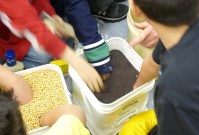
Students getting hands-on with soybeans and canola during a CALM presentation
He continues to participate in CALM, extending the learning and allowing his students to connect with area farmers. The ripple effect from AITC’s programs, combined with Akerley’s engaging teaching style and passion for learning, is effecting positive change in the community.
We all have that one teacher who made a positive impact on our lives. There is no doubt that ‘Mr. A’ is a difference-maker who will be remembered by many. His enthusiastic participation emphasizes the value and far-reaching benefits of having, and continuing to grow, AITC programming across the country.

 Last fall
  I am fortunate to have so many phenomenal women who support me not only within my comfort zone, but also nudge – or sometimes pull me – beyond my safety net showing me how much more I am capable of accomplishing. They help me shine brightly when all I want to do is hide under the covers. They celebrate my successes and help me learn when things don’t go as planned. They point me in the right direction when I’m feeling lost. They laugh with me, dance with me, listen to and stand by me. They inspire me with their intentional lives, acts of kindness and bravery. Their presence in my life has made me a better person. Knowing they are there for me is both reassuring and empowering.
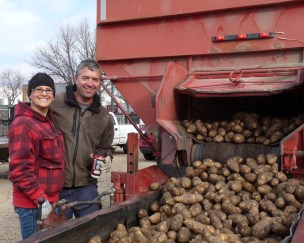 How does it feel to give away 35,000 lbs of potatoes in just under 5 hours?
 “What I loved about it, is that we’re not just targeting one sector of our community. We had people of all ages, all income brackets and walks of life stop by,” said Mark. Many people on fixed incomes and social assistance came up to him to express just how much this was helping them out, shake his hand and thank him. Others stopped by out of curiosity or because they knew the Peters. Some didn’t even need the potatoes but just thought it was a cool idea.
 Inadvertently it also bridges the farmer-consumer gap. The young ones in the crowd often opened up the best conversations. “Why are the potatoes dirty?” ”How come there are so many different shapes and sizes?” “Why are you giving them away?” Many discussions ensued on food waste, what happens to produce before you find it on your store shelves, and why it feels good to give back when you can.
 Many asked if this will be an annual event. When it comes to farming, it all depends on the year and success of the crop. The Peters remember and appreciate how generous people were with them when they were young adults, so when they are in a position to give back, they definitely will.
 Despite the cool Saturday morning, people were already lined up by 8:30 – a half hour before the Portage Community Potato Give-Away was slated to start. They came pushing strollers, riding bikes, walking and on scooters, as well as by car and truck. Many heard about the event on local media or on-line, while others just happened by and wondered what all the fuss was about.
 Those who had excess garden produce — tomatoes, beets, carrots — brought it by to share with the crowd. Others dropped off bags and boxes to ensure those who didn’t have containers had something to cart their potatoes home in. One young family stopped by to get their spuds, then stayed to help others gather theirs.
 Inadvertently, the event also offered an opportunity to agvocate (advocate for agriculture) and engage in farm to food discussions. The young ones in the crowd often opened up the best conversations. “Why are the potatoes dirty?” “How come there are so many different shapes and sizes” “Why are you giving them away?” So discussions ensued on food waste, what happens to produce before you find it on your store shelves, and why it feels good to give back when you can.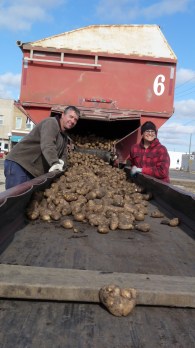
 A simple thank you or word of encouragement can go a long way to making someone feel valued for doing their job. It isn’t difficult, time-consuming or costly. Serving the public can be trying, and often only the negative is conveyed. Positive feedback is always appreciated and often leaves us feeling better as well.
 Sandi Knight