Weathering the Rain

Originally published in the Manitoba Cooperator October 6, 2016 

Reflections on the seemingly endless rains this past growing season. For many across western Canada, snow was added to the mix in early October and harvest continues to be an ongoing challenge for far too farmers.  Thinking of those who are struggling to get their crops from the field to bin and hoping everyone will soon be done with #Harvest16.  


facebook_1474855006708I used to be that girl, the one who would joyfully head outside when it rained. I loved everything about it. The rhythmic sound on rooftops. The patterns it made as it rolled down windows. The feel of rain on my cheeks. The way it would it soak through and soften my wild, curly hair. If the rain was coming down fast and furious, I was content to sit under the cover of the front porch and watch. But the best rains were gentle, light, perfect for walking. The air so fresh, the streets quiet and still. Those rains offered a refuge from troubles and worries. I can still see my younger self soaking in the peace and serenity of those walks.

Yet there I sat, staring at the computer screen, tears instead of raindrops, slowly rolling down my cheeks. A friend was embracing and enjoying that night’s rain. Her post on social media read, “Jammies, slippers, hoodie, book, veranda, rain! Wonderful combination. .oh yes..glass of wine.”  She was doing exactly what I believe in and strive for — embracing the moment. But instead of being happy for her, I was jealous. Not of what she had, or what she was doing, but of that feeling, that freedom, that joyful connection to the rain.

I had the comfy clothes, books and wine, maybe not the veranda to relax in; that wasn’t the issue. What really got to me was the fact that she was enjoying the rain — and I wasn’t. In fact, after almost 3 months of excessive rains, I was cursing yet another downpour that was downgrading our wheat and delaying the start of harvest.

You would think after 27 years of farming, I would be used to it, but that night the dismal weather really weighed me down. I missed being that girl and my past laissez-faire relationship with the weather.

When your income is dependent on Mother Nature, your relationship with the sun and rain becomes fickle.  Excess amounts of either, especially at critical times during the growing season, can cause anything but joy and relaxation. The hold the weather has on our lives, can at times, be tiring.

I’m rather embarrassed by my feelings that night; jealousy is not an admirable trait. And being jealous of a feeling — well, that borders on absurd. I confessed to my friend. She totally understood, but we agreed the next time that happens, I am to join her.
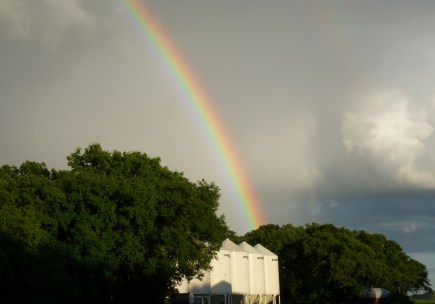
rainbowI spoke to another woman, who has long since retired from farming and asked her if concern for the weather ever goes away. She laughed, “No.” So I guess I’ll have to be content with my memories of that girl. Look back on her fondly and smile. Even when we no longer work the land, concern for farmers will always be there, and I will be that little old lady who politely asks, “So, was that a good rain?”


It helps to talk to someone who listens and understands. No matter the issue, you can contact the Manitoba Farm, Rural & Northern Support Services. They offer free, confidential information and non-judgmental support, for anyone who lives on farm, rural or northern community. Call Toll-Free 1-866-367-3276 Monday – Friday 10 a.m. to 9 p.m. After hours 1-888-322-3016

A list of nationwide resources in Canada can be found here


Harvest Meals – Tips and Tricks

Originally published on Canola Eat Well  blog on August 31, 2015 

Harvest is now underway, albeit in fits and spurts in many areas of the country as wet weather continues to hamper efforts.  Here are a few tips to help ease the stress when it comes to meals to the field. 


Preparing and taking meals to the field during harvest can be a challenge. Some people make it look effortless, but they will be the first to tell you lessons learned along the way helped them hone their skills. They also advise it isn’t always the idyllic picture of everyone sitting around the makeshift table on the tailgate of a truck, a beautiful array of food spread out, light breeze blowing, everyone happy, relaxed — and that’s okay. Here are a few pointers from the voices of experience.

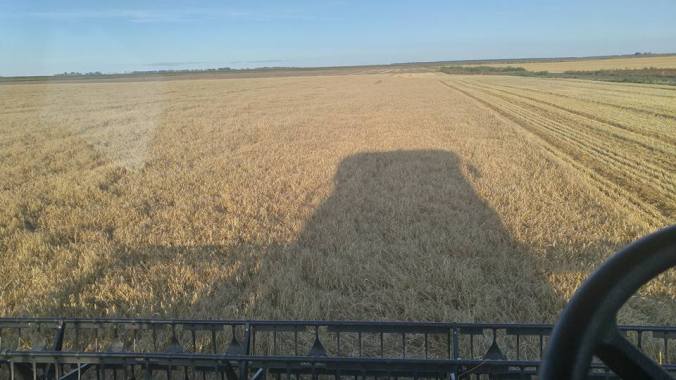
Perry combining wheat 2

Harvesting  wheat – view from the combine cab    (P. Knight photo)

Food:
  • Become friends with your slow-cooker. Embrace stews, chili and casseroles. All-in-one-meals can incorporate each food group and are easy to transport.
  • Have a good supply of clean vegetables and fruit in the fridge for quick preparation.
  •  Take advantage of rainy days to bake or make freezer-friendly meals.
Leaving Home: 
unnamed

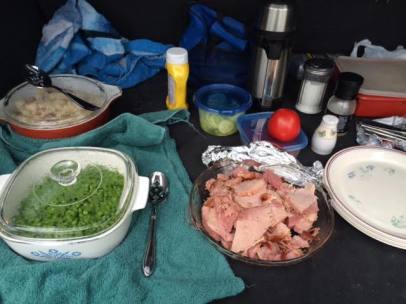
Photo Courtesy of Roberta Galbraith

  • Make a checklist, especially if you are travelling to a field several miles away. Food, drink, utensils, chairs etc.
  • Have a storage caddy filled with cutlery, napkins, hand sanitizer, wet wipes, cups and plates. Camping dishes are ideal to use if you have them.
  •  Old towels make great insulators for keeping food warm. They absorb any spills and are easy to wash.
Getting There:
P1160916

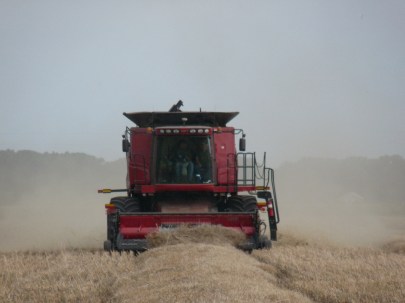
Harvesting Canola

  • Ensure communication is clear. Exactly which field are they working in? Especially critical if it is early in your marriage when you aren’t familiar with each field’s ‘name‘.  “We’re on Bill’s”, or “At the McLeod farm”, may be meaningless to you, especially if Bill or the McLeods haven’t owned that land for several decades…                                                                                                                                   Cell phones and road numbers have definitely aided in alleviating navigational struggles.
  •  When swarms of mosquitoes and flies are abundant, it may seem genius to borrow your in-laws motor home to deliver supper. However, ensure you park on stable ground as getting said ‘kitchen-on-wheels’ stuck is more a hindrance than help to harvest progress.
No Time to Stop:
  • Small coolers which hold both food and drink, makes for a quick and easy hand-off and eliminates spills. 
  •  Sandwiches and wraps are perfect for on-the-go eating. Just remember to advise if you have used toothpicks to help hold them together…
  • Quiche works too, either hot or cold, with a side of raw veggies and a bun or biscuit. “Real men don’t eat quiche,” they say? Why argue when a simple name change will do? Who can resist “Bacon & Egg Pie”? 😉

A little preparation, communication, flexibility and sense of humour all help at this busy time of year. May your harvest meals be made and delivered with ease, and any memorable moments shared and treasured for years to come.  Wishing you a safe and abundant harvest, from our farm to yours.

Simply Canola

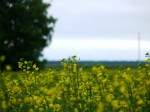
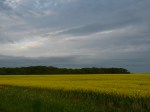
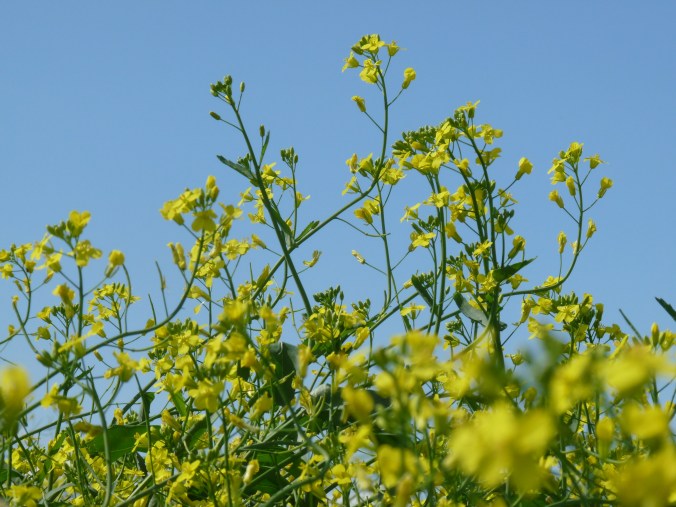
There is no denying  canola has been the shining star of agriculture across western Canada this past month — as it is every summer when in bloom.  It isn’t unusual to see people stopping alongside the road to snap a picture, or take a selfie against the gorgeous sea of yellow this crop provides. 

Even those of us who grow it, are taken in by the allure of those bright and beautiful blossoms and have been know to take a picture, or two, perhaps more… I’ll admit I may have gotten carried away this year, but the opportunity was irresistible and right out my backdoor. 

We are proud to be one of the over 43,000 Canadian farmers producing this heart-healthy, versatile, edible oil. These are a few of my favourite shots taken on our farm from June 22nd to July 18th. I hope you enjoy my 2016 canola pictorial diary.  

*Click on the pictures for additional description and information.  

Ag careers are waiting for you!

Dear Grad,

mirrorIt’s finally here – high school graduation! A long-anticipated, exciting time, perhaps filled with a bit of trepidation of what the future holds. Do you have a clear vision and goal of what you want to do and where you want to go? If not, why not consider a career in agriculture?
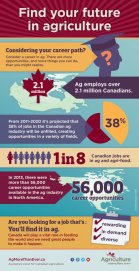
You don’t have to be from a farm, or even from a rural area. If you are at all interested in food and food production, the job opportunities are endless. All you need to bring to the table is a desire to learn.

Ag job factsCurrently 1 in 8 jobs in Canada are connected to agriculture and agri-food production. It is estimated by 2022 there will be 74,000 job openings in the Canadian agri-food sector but one third will go unfilled. There is an opening waiting for you!

While many jobs are directly connected to farming – agronomists, veterinarians, grain and livestock marketers, truckers, mechanics, financial lenders, auctioneers, salespeople – there are so many others related to agriculture.

Research is always ongoing – with plants, animals, soils and the environment along with food processing, transportation, refrigeration and storage. The science behind leading-edge technology and genetics is exciting and ever-changing.

Ag - food demand growthMethods of producing food go beyond the field to greenhouses, hydroponics and aquaculture. World food demand is set to grow by 60 per cent by 2050. The amount of land we have is limited but ideas and innovation for increasing food production are infinite.


Agricultural economics, policy and law play an important role in our industry. Negotiations and trade talks can involve travel all over the world.

As the number of people directly involved in farming continues to decrease, the importance of communication is increasing. We need writers, broadcasters, reporters and social media professionals to ensure factual information is clearly presented to consumers.

Home economists, dietitians and teachers have opportunities with every commodity group and organizations such as Ag in the Classroom, Farm & Food Care and The Canadian Centre for Food Integrity.

Manufacturing and engineering continue to evolve we strive to farm more efficiently. Computer programming, GPS and precision technology are all key in every aspect of our industry.

How about event planning? Conferences, trade shows, tours, meetings, educational and community-connection events all require skilled organizers and promoters.

The business of producing food for a growing world with limited resources is a complex team sport. There are so many facets to chose from – pursue an interest you’re passionate about and join our team! We’re excited to see what you bring to the table.


Check out these great videos showcasing the opportunities waiting for you!

Your Life – Your Agriculture  and Dreams Can Come True with Agriculture

2016 Photo Exhibit

“Out my backdoor”

 Portage & District Arts Centre Boardroom Gallery Photo Exhibit 2016

l truly enjoy capturing images and moments in time, whether bright and bold, or small and subtle. No matter the season, every day offers something to make me pause and appreciate my surroundings. 

These unedited images were taken with a simple point-and-shoot camera.  Mother Nature provides the settings – all I have to do is be in the right place, at the right time. I like to share exactly what I see when I look through the lens. 

*Click on the pictures for additional description.  


See a picture you like?  8×10 prints are available $40 CDN.  Fill out the form below. We’ll send an invoice to the email you provide. Once payment is received via PayPal or credit card, your prints will be shipped.  ($5 shipping charge anywhere in North America.)

Go back

Your message has been sent

Warning
Warning
Warning

Warning.

Engaging youth in agriculture

Originally published March 3, 2016 in the Manitoba Cooperator


Becky Parker is a young woman with a vision and passion — to engage and educate youth about agriculture, the agri-food sector and it’s many career opportunities.  She is a Project and Partnership Strategist with Ontario Agri-Food and Education    and a Nuffield Scholar researching models of ag career education.

She shared a rather startling fact at Manitoba Ag Days in January.  It is estimated that by 2022 there will be 74,000 job openings in the Canadian agri-food sector but one third will go unfilled. In fact, Farm Credit Canada has identified a labour shortage in agriculture as the leading risk management factor for our industry.

Parker believes the answer to the labour shortage is sitting in our Canadian classrooms right now.  “There’s a feeling, there’s an identity to working in agriculture,” she said.  We need to excite and engage young people, yet remain realistic. Certain jobs aren’t for everyone, especially in primary production. Many students admit, it is “too much work.” So how can we sell these jobs and open their eyes to other job prospects in agriculture?

First, we need to work on perspective, she advised.  So many view agriculture as farming and/or being a farmer and are unaware of the many other opportunities that exist. Everyone in the industry can work on this issue.

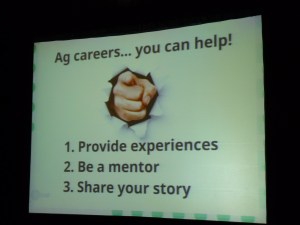
We can start by providing students with hands-on experience — field trips to farms or ‘take a kid to work’ days.  Connect with school guidance counselors and consider apprenticeship programs. Share information on resources.  Ag in the Classroom offers  a variety of learning opportunities for students of all ages.  GrowingCareers.ca is a website designed for both educators and students to explore careers in the agri-food sector.

Secondly, “Be a mentor or teacher,”  Parker stated.  Volunteer with Ag in the Classroom or 4-H. Host a meeting or ag forum, share your experience. Consider what other countries are doing. In New Zealand Get Ahead Career Experience Days are held across the country where students not only meet a variety of successful professionals in the ag industry, but also complete a hands-on activity associated with a particular job. The impact is powerful and positive.

Australia has an Art4Agriculture program where students research an agriculture commodity or issue and present their findings through art on a fiberglass cow – a very innovative and memorable way to teach. It not only brings the farm into the classroom but builds relationships between schools, industry and business while raising awareness of career pathways.

But sharing your story, Parker told the audience, is one of the most important things P1130965you can do. That doesn’t necessarily mean talking about ‘what’ we do – it is far more powerful to share the ‘why’. We are far more likely to inspire if we share the reasons and the passion behind our career choice. Social media provides a great platform but volunteering or everyday conversations also offer opportunities.

Being proactive and starting early will open students’ eyes to the wide variety of jobs available. We each need to do what we can to engage the next generation and ensure a labour shortage will not be a crippling issue for agriculture in 2022. Whether it is on our own or by other means, she encourages all of us to “Step up to plate, and swing the bat.”

Dreams Can Come True with Agriculture

What is a Farm Woman?


To celebrate International Women’s Day, I am sharing a toast written for the 29th Manitoba Farm Women’s Conference  ~ November 16, 2015 


What is a farm woman? According to dictionary.com “a woman who operates a farm or cultivates the land; a woman who lives on a farm.” That’s fairly straightforward.

20151108_120146Urban dictionary paints a more creative definition of a farm girl, “independent woman. can ride horses and four-wheeler’s. can drive anything with four wheels. loves to drive trucks and tractors. they are lovers and fighters. raised up right. can wake up at anytime of the day and can stay out all night. tears up old dirt roads and speeds down gravels. they usually have big hearts and sometimes care too much. animals are a main love in their lives. special in various ways.”  Well now, that certainly paints a commanding presence!

Are these definitions reflective of today’s farm women? Depending on who you ask, “Yes”, “No”, “Maybe…”, and even a resounding, “Absolutely not!”

So what does define a farm woman in today’s world? Agriculture is ever-evolving and so are we. We are a diverse group with various backgrounds, abilities and strengths.    It is no longer expected that as farm women, we only have one role, or that over the years, it has to stay the same. We can choose a job we love, a job we are good at, a job we want and do it in a way that suits our lives – whether it is on or off the farm.

There is no single, set description that encompasses us all. Whether you define yourself as a farmer, farm partner or farm wife, every position on your farm ‘team’ is important and valued.

P1120941For me, this conference has always been a celebration of our diversity and our strengths as well as a time to learn and grow. No matter my role in our farm operation, I have always felt supported, uplifted and celebrated by being here with you.

So tonight, I am honoured to propose this toast. By choosing to do what you love, you do it well. You contribute to your family, your farm, your workplace and your community in a variety of ways. You continue to learn, grow and push boundaries.

You may or may not be able to ‘drive anything with four wheels’ but I believe you have been ‘raised up right’. You may or may not be able ‘stay out all night’, but you have a big heart and care deeply. You are most definitely ‘special in various ways’.

You deal with a multitude of challenges and can adapt to change. You take nothing for granted and find the positive in every day. You inspire those around you. You are strong, capable, determined. You are beautiful inside and out.

20160213_172335Never doubt your abilities or your capacity to learn. Believe in yourself as others believe in you. This morning Carol Ann Fried asked, “What is your dance?” No matter your style, embrace it – and be sure to use the whole dance floor! Take Jill Officer’s message to heart and always “Go your own way!” Here is to celebrating you, and continuing to support, encourage and uplift each other on this amazing, ever-evolving journey as farm women.
Innovation in Oil

Originally published January 2016 in Canola Digest


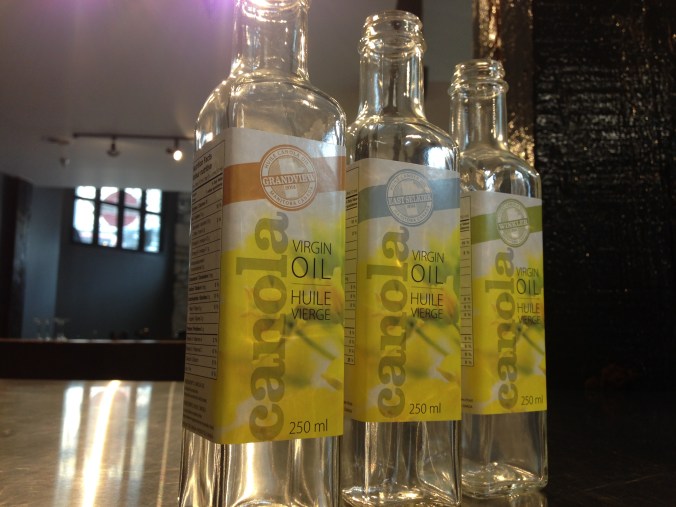
Three Manitoba canola growers are bottling and marketing canola oil with flavour characteristics unique to their own farms.  As grapes produce different flavour subtleties in wine based on their “terroir” – a  French word that covers soil, topography and climate – so does canola from different regions produce slightly different oil.

Photo courtesy of MCGA

Photo courtesy of MCGA

The Manitoba Canola Growers Association (MCGA) and the Manitoba Agri-Health Research Network Inc. (MAHRN) are studying virgin, cold-pressed canola oil, meal and co-products from processing as part of a Canadian Climate Advantage Diet (CCAD) project funded by Growing Forward II.  The three-year $396,000 project is looking at how the interaction between plant genetics and local growing conditions impacts the nutritional profile, flavour characteristics and end-use qualities of Manitoba-grown canola.  MCGA has contributed $10,000 to the project with a goal of adding value and finding innovative uses for Manitoba-grown and processed canola. The venture addresses the keen interest consumers have in local food, ‘terroir’ and virgin cold-pressed oils.

The three farmers involved to date are:  Brian Chorney of East Selkirk, Jack Froese of Winkler and Larry Bohdanovich of Grandview. They all grow the same variety but, surprisingly, the look, taste and even the nutritional profile of each oil is different. The East Selkirk Vintage has a higher iron content. The Grandview oil has a higher vitamin A number, is the strongest in flavour and has the deepest gold colour. Variations also exist in the percentage of crude oil extracted (33.9 – 39.5%) and clarified oil recovered (68.14 – 69.5%).  East Selkirk has the highest rates.  (Note that cold-pressing cannot extract as much oil from the seed, resulting in a high-oil meal.)

Photo courtesy of MCGA

Photo courtesy of MCGA

These unique, cold-pressed oils were test marketed at both the retail and food service level with highly favourable results. They are being embraced for salad oils, drizzles and a Canadian-grown alternative to extra-virgin olive oil.

The 2015 Vintages, prominently labeled with each growing area, will be available in early 2016 at five Winnipeg Red River Coops as well as the Winkler Co-op. These new virgin canola oils are also part of the Buy Manitoba Program. Such distinctive specialty oils demand a premium and sell at 20 times the price of conventional canola oil.

The long-term goal of this project is to develop on-farm enterprises and small and medium-sized business product lines. “It’s always exciting to see innovation in agriculture and Manitoba canola growers are definitely excited about growing future prospects for canola in Manitoba,” says Ellen Pruden, education and promotions manager with MCGA.

DEFINITIONS

Terroir (ter-war):   A term most often associated with grapes and wine, this is the special set of characteristics expressed in agricultural products when the geography, geology and climate of a location interacts with plant genetics. As a result of this project, we now know terroir exists in Manitoba-grown canola.

Cold-pressed oils:   Obtained by mechanically pressing and grinding the seed at a slow speed. Cooling methods are in place to ensure the temperature does not exceed 60 C during this process.


A GMO by any other name would smell sweeter

Originally published March 19, 2015 in the Manitoba Cooperator

The terminology used to describe modern plant breeding gives it a bad name


Canola in bloom

Canola in bloom

Google reveals a plethora of ideas for “How to choose a name.” It has suggestions for your baby, your dog, your business, your blog and more.

Have you ever wondered what the discussion would be around food and agriculture if plant scientists sought similar advice when naming genetically modified organisms (GMOs)? They’re immersed in science, their everyday field, and the terminology of their everyday language. “Transgenic plant breeding” and “biotech crops” are also used to describe the breeding methods, but the terminology has created fear, apprehension and misunderstanding for many consumers. Even when people do not know what a GMO is they believe they should be feared and avoided. For an example, see “What’s a GMO?” for Jimmy Kimmel’s take on the subject.

So instead of technology moving forward to provide solutions to drought, famine and disease it sits on a shelf while a heated public debate ensues.

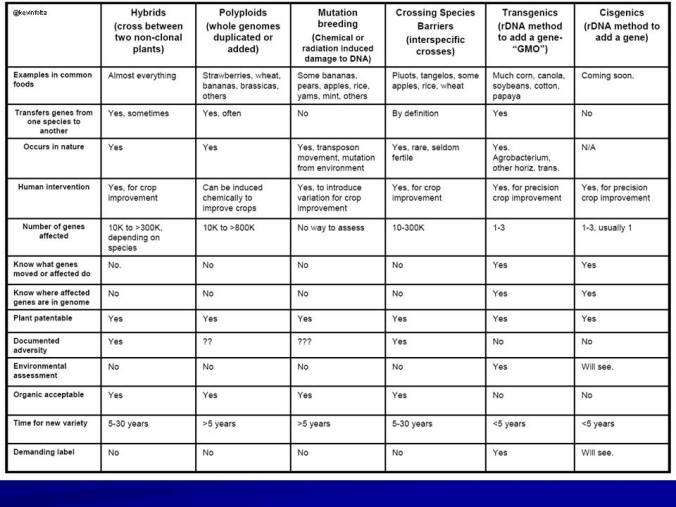
But where would we be if a different name had been chosen? GMOs are a precise extension of conventional plant breeding, changing only one to three genes instead of 10,000 to 800,000. It takes less than five years to develop a new variety as opposed to five to 30 years. It is a straightforward, accurate, timely and effective process. Humans have been manipulating plant genetics for more than 10,000 years but only recently have breeding practices been called into question. Is it possible the name contributed to the skepticism?

Would have “precision plant breeding” better suited the process? Would have it instilled confidence instead of fear? Enthusiasm instead of activism? We will never know, but as the #farmtofood conversation continues to grow, perhaps we should re-examine the terminology we use and the names we choose.

If we are to bridge the gap between science, industry and consumer, care should be taken to ensure our language is building bridges of understanding not fences of fear. A name needs to be representative and descriptive but should also be clear and concise to all.

Folta alleviates fear of science

Originally published in the March 2015 Canola Digest


Agriculture and food production are in the spotlight now more than ever and GMOs are on the hot seat. But the science is often misunderstood.

Dr. Kevin Folta, horticulture professor and research scientist from the University of Florida, spoke about communicating science at the Manitoba Canola Growers Association’s “Does science belong on my plate?” event in Winnipeg in October.

Kevin Folta - photo by Tyler Jones.

Kevin Folta – photo by Tyler Jones.

Speaking to home economists, dietitians, students, food bloggers, consumers, farmers and industry members, Folta broke down the science, dispelled myths and alleviated any fears one might have had over how our food is produced.

He began by addressing the trepidation consumers have of genetically-modified organisms (GMOs) despite not knowing exactly what they are or how they work. He asked the group if they knew how many crops currently use this technology. The answer in October was eight — corn, canola, soybeans, cotton, alfalfa, papaya, sugar beets and squash. FDA approval of Simplot’s Innate potatoes in November 2014 makes nine.

Folta explained that “transgenic”, rather than GMO, is a more accurate description, meaning plants contain a gene inserted using recombinant DNA technology. This is a precise extension of conventional plant breeding but changes only one to 3 genes instead of 10,000 to 800,000 that can change through conventional breeding. And it takes less than 5 years to develop as opposed to 5-30 years through conventional breeding.

Plant Breeding Chart - courtesy Kevin Folta

Plant Breeding Chart – courtesy Kevin Folta

He described how genes are transferred. It is a straightforward and effective process, not resembling at all the “frankenfood” images often seen on the Internet. And it is tested and safe. In 18 years, not one case of illness or death has been related to GMOs.

While the technology may be relatively new, he reminded us that humans have been manipulating plant genetics for more than 10,000 years. As the world’s population increases, moving forward in developing genetics and production methods will generate better quality and increased yields on the same land-base with fewer inputs. Resistance is one limitation, but this can be overcome.

Many consumers want “natural” food, but Folta advised that nothing we eat is natural. It has all changed from its original form.

Courtesy Kevin Folta

Courtesy Kevin Folta

The public is hungry for knowledge, but torn as to who to believe. Fear and risk are being manufactured and sold by so-called experts, he says. Correlation, not causation is being cited. Biotechnology is only part of the solution in feeding our growing world, but it shouldn’t be opposed for invalid reasons.

The most sobering part of his presentation was learning of available solutions being blocked because of misinformation, fear and activism.

Strawberries could be grown without fungicides by allowing a single gene within the strawberry to be “turned up” all the way, he says. Biotech “golden” rice, rich in Vitamin A, could prevent blindness and death. Root disease could be stopped in cassava, a nutrient rich root vegetable. Drought-resistant corn could be grown. The allergy gene in peanuts could be “turned off”. Black spot and wilt could be prevented in tomatoes. Oil content and quality improvements could be made in soybeans and canola. Diseases could be stopped in grapes, eggplant and citrus crops.

While this technology sits on a shelf, the benefits to farmers, consumers and the environment are being delayed. Most striking are solutions to drought, famine and disease in developing nations not being implemented because of activism from first world countries where food is abundant, plentiful, affordable and safe.

As a farmer, I believe if all concerned consumers had the benefit of attending this informative event, the debate over how our food is produced would stop. The evening was invaluable as a resource for advocacy. If we and others in the industry are able to share our stories and answer questions, perhaps we can help advance science and reason to ensure productive steps continue to taken to improve agriculture methods and food production around the world.


More information on GMOs can be found via the links below.

GMO Answers

Talking Biotech Podcast

Biofortified Blog

Genetic Literacy Project