Final Farewell

For as much as death is a part of life, we frequently get it wrong when attempting to offer comfort.  Support often needs no words.  We can be there for each other and simply allow the grief.


Final Farewell

A river of cards swells across the dining room table.
Overwhelming sadness grips my heart.
Sympathetic words echo in my mind.
Some offer comfort; others try…
“The suffering is over.”
“It was meant to be.”
“She’s at peace now.”
“It’s a blessing.”
Why do they feel the need to rationalize death?
No amount of logic will fill the vast emptiness I feel.
I have lost someone I love.
Allow me my sorrow.
Allow me my tears.
Allow me to grieve.
In time, I will move on, but not yet, not today…
It is time to reflect on a lifetime of memories,
to celebrate the time we had together,
to say a final painful farewell.

Sandi Knight © 2010

Happiness in a Cookie

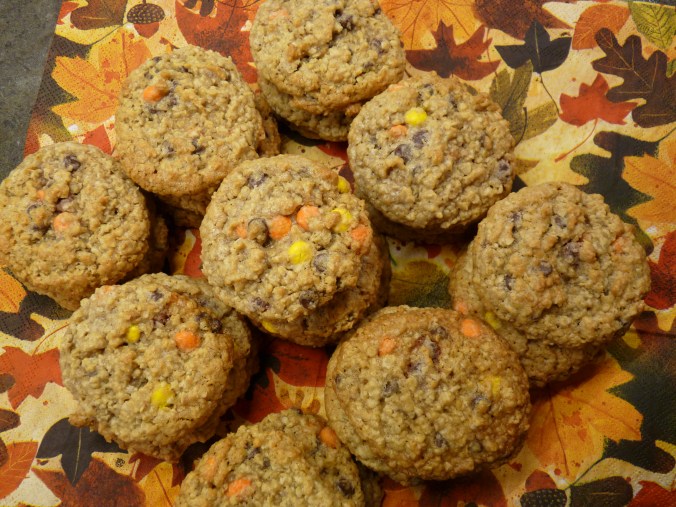
This oatmeal chocolate chip cookie recipe always gets rave reviews — a favourite amongst family and friends for many years.  It is the cornerstone of care packages for my now grown children and always made when they come home to visit.  The aroma and melt-in-your-mouth goodness of this fresh-baked cookie is delectable! 

(Adapted from a Cranberry-Oat Cookie recipe in a 2001 Robin Hood Baking Festival booklet.)   

Happiness in a Cookie

P1070882

Ingredients:

  • ¾ cup butter, softened
  • 1 cup packed brown sugar
  • ¼ cup granulated sugar
  • 1 egg
  • 2 tbsp water
  • 1 tsp vanilla
  • 2/3 cup flour (I like to use 1/3 barley flour & 1/3 all purpose flour)
  • ¾ tsp baking soda
  • ¼ tsp cinnamon
  • 2 ¾  cups quick-cooking oats
  • 2/3 cup chocolate chips

Directions:

  1.  Pre-heat oven to 350°F (180ºC)
  2.  Beat or cream together butter, sugars, egg, water and vanilla until very smooth.
  3.  Add flour, baking soda, and cinnamon to creamed mixture, blending well.
  4.  Stir in oats and chocolate chips.  (dough will be slightly sticky)
  5.  Using a 1 tablespoon cookie scoop, drop dough onto baking sheets.
  6.   Bake for 12-15 minutes, until edges are golden-brown. Do not over bake.
  7.  Let sit on baking sheets for 2 -3  min. before removing to cool.

Notes:

I  normally use 1/3 cup semi-sweet and 1/3 cup dark chocolate chips but sometimes substitute 2/3 cup mini M&Ms or Reese’s Pieces.  If you don’t like chocolate (seriously???) use any combination of raisins, cranberries, walnuts, pecans or coconut.

Mini Reese's Pieces ~ Perfect for Halloween!

Mini Reese’s Pieces ~ Perfect for Halloween!

Storage:

What isn’t eaten immediately, can be stored in a resealable container on the counter for 1 -2 days or in the freezer for up to a month.  Generally they disappear pretty quick…

Three Gifts for You

This is an edited version of my first published article. It was printed in the Farmers’ Independent Weekly in December 2003 after an exceptionally difficult year in our industry.  At that time I wrote:

“To say it has been a challenging year for agriculture would be an understatement.  BSE (bovine spongiform encephalopathy), combined with the usual factors out of our control, including Mother Nature and market prices, has placed economic hardships on many farm families across the country. If I could offer three gifts to them it would be financial stability, high record setting commodity prices and ‘true’ free trade. Unfortunately, all I can offer are three simple wishes. My wishes are not gifts that can be wrapped and placed under a tree. They cost not a penny, yet are priceless commodities for the human spirit.” 


With Christmas only days away, everyone is out searching for the perfect gift. The stores are bustling with people purchasing presents for those they love. However, in my eyes, the best gifts cannot be found in any store. If I could offer anything, it would be three simple wishes.

My first wish is serenity. I hope you have a place to find serenity. It may be a peaceful walk in the country, visiting a library or art gallery. Maybe you have a fireplace where you can curl up with a cup of tea. Perhaps you have a favourite chair in a quiet room – try adding music, candlelight or that book you’ve been meaning to read. You might find serenity in the face of a sleeping child or in the beauty of a sunset or sunrise. This time of year the glow of Christmas lights adds a peaceful and warm feeling to your home. Serenity is food for the soul and both you and those around you will benefit from it.

My second wish is faith. Faith means many things to many people. We are fortunate to live in a country where we have the freedom to choose our faith. There is also another type of faith. It is the faith that keeps us going when times are difficult – believing things will get better and believing in the resiliency of the human spirit. You may find your faith in a place of worship. Perhaps a visit at the kitchen table with a good friend can restore your faith and renew your spirit. You may find faith in the kindness of strangers or in the eyes of a child. Faith may be buried deep inside you or found in the beauty of nature. When you gaze upon a magnificent prairie sky or watch the northern lights and millions of stars above, how can you not have faith?

My third and final wish is humour. Where would we be without laughter? It provides both a physical and emotional release, reducing stress and increasing relaxation as well as boosting our immune systems. Laughter can re-energize you, give you strength and put life into perspective. You may find humour in a television show, movie, old pictures or a favourite comic strip. Or how about a visit with that one friend that can always make you lighten up and laugh? Having a sense of humour helps us cope and keeps us moving forward.

Imagine these gifts under your tree this Christmas. May serenity, faith and humour be with you always and help you deal with the many challenges life brings your way.

gifts


Flooding Hurts Food Production

Originally published August 4, 2015 in the Winnipeg Free Press  


No one wants to discuss it. Even those most affected are careful how they reply when asked about it: “Do you really want to know or are you just being polite?” Because in fact, yes, flooding is still an ongoing issue around Lake Manitoba.

As I write this, gale force winds are Lynch's Point Waves - lg web sizeincreasing the lake level in the south basin by five feet or more. Significant and powerful wave action will force water inland up to two to three miles, flooding pasture, hay-land and crops. It is the fourth time in five years that an over-flowing Lake Manitoba has stolen the income of farmers and ranchers.

Imagine owning a modest, ten table restaurant. You and your family are making a decent living, able to pay your bills, look after your home, send your children to school and financially contribute to your community. Your restaurant is definitely not a get-rich-quick scheme, but you’re financially stable, providing a service along with local employment.

Then one year, the government decides to shut down five of your tables. The next year two or three. There is nothing wrong with your tables or your restaurant, they just aren’t allowing you to use them to ensure the restaurant down the road in a larger, more important centre can remain viable. You still have all your overhead costs but your ability to generate an income has dramatically decreased. How long could you keep your doors open? Would you find this government action acceptable? What would you do?

In 2013, farmers tried to bring attention to their plight with a peaceful 12-hour protest at the Portage Diversion. The government labeled them “angry, irresponsible farmers” and court orders were served. A meeting was held alongside the diversion last July when record flows of Assiniboine River water were once again thrust into Lake Manitoba, bringing it above flood level, but no other public gatherings have taken place since.

Countless phone calls and e-mails, and months of waiting are required to get a response, if any, from the departments of Agriculture and Infrastructure and Transportation. This month a joint letter from both departments to our farm stated, “To protect as many Manitoba homes and properties as possible, our government managed water flow with the Portage Diversion.” Well that management continues to cause significant financial losses for producers all around the lake. But instead of compensation, the response we received, “We recognize the impact flooding has had on individuals like yourself, and appreciate your contributions to Manitoba’s agriculture sector.” Unbelievable.

Farmers and ranchers are in the business of food production. As long as this lake is kept full and overflowing, it is increasingly difficult to remain viable and plan for the future. If the government is intent on keeping it at high levels, tell us. Compensate for losses. Buy the intentionally submerged and quagmired land that we still have to pay taxes on despite being unable to use.

An outlet for Lake Manitoba is supposed to be built by 2020 but five more years of uncertainty, five more years of being on continual wind-watch, five more years of preventable financial losses is unacceptable. A restaurant cannot operate when the government keeps shutting down tables and a farmer or rancher cannot continue to operate when their land base is continually degraded and stolen.

The 2011 Flood wasn’t a one-in-350 year event. High water levels remained in the spring of 2012. One year of recovery was available in 2013 but any hopes of forages being re-established and seeded crops surviving was once again swept away in 2014.

Farmers and ranchers have not been fully compensated. For many, the financial losses of 2011 were only partially covered and even though multi-year compensation was promised, reimbursement continues to be denied.

And what about the emergency outlet built after 2011? That is on Lake St. Martin, not Lake Manitoba (which flows through Fairford and into Lake St. Martin). It use has been sparsely used and definitely not to full capacity.

Farmers and ranchers have been taught to be patient — a necessity in dealing with mother nature — but patience is wearing thin as financial costs of this ongoing flood continue to mount. The blatant disregard by this government to the people and communities around Lake Manitoba is astounding.

Ask yourself if you would be willing to forfeit a portion of your income four out of five years, and possibly more, to protect your neighbours from flooding. Right now, farmers and ranchers have no say, no choice. Their income is stolen, with thanks for their contribution to agriculture. Some gratitude.

A GMO by any other name would smell sweeter

Originally published March 19, 2015 in the Manitoba Cooperator

The terminology used to describe modern plant breeding gives it a bad name


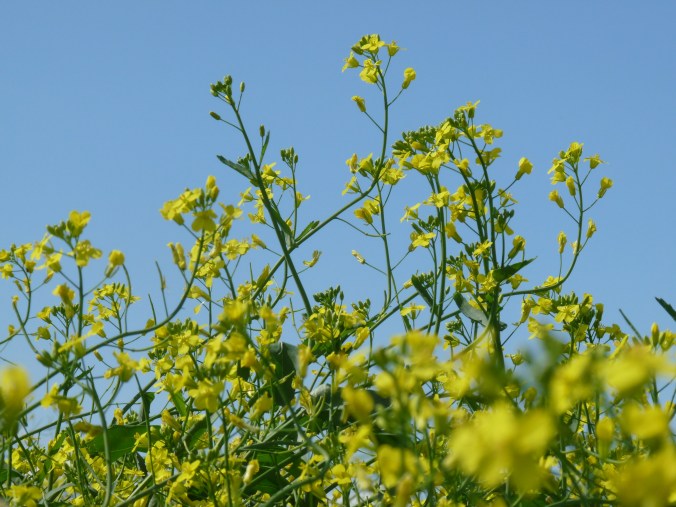
Canola in bloom

Canola in bloom

Google reveals a plethora of ideas for “How to choose a name.” It has suggestions for your baby, your dog, your business, your blog and more.

Have you ever wondered what the discussion would be around food and agriculture if plant scientists sought similar advice when naming genetically modified organisms (GMOs)? They’re immersed in science, their everyday field, and the terminology of their everyday language. “Transgenic plant breeding” and “biotech crops” are also used to describe the breeding methods, but the terminology has created fear, apprehension and misunderstanding for many consumers. Even when people do not know what a GMO is they believe they should be feared and avoided. For an example, see “What’s a GMO?” for Jimmy Kimmel’s take on the subject.

So instead of technology moving forward to provide solutions to drought, famine and disease it sits on a shelf while a heated public debate ensues.

But where would we be if a different name had been chosen? GMOs are a precise extension of conventional plant breeding, changing only one to three genes instead of 10,000 to 800,000. It takes less than five years to develop a new variety as opposed to five to 30 years. It is a straightforward, accurate, timely and effective process. Humans have been manipulating plant genetics for more than 10,000 years but only recently have breeding practices been called into question. Is it possible the name contributed to the skepticism?

Would have “precision plant breeding” better suited the process? Would have it instilled confidence instead of fear? Enthusiasm instead of activism? We will never know, but as the #farmtofood conversation continues to grow, perhaps we should re-examine the terminology we use and the names we choose.

If we are to bridge the gap between science, industry and consumer, care should be taken to ensure our language is building bridges of understanding not fences of fear. A name needs to be representative and descriptive but should also be clear and concise to all.

Folta alleviates fear of science

Originally published in the March 2015 Canola Digest


Agriculture and food production are in the spotlight now more than ever and GMOs are on the hot seat. But the science is often misunderstood.

Dr. Kevin Folta, horticulture professor and research scientist from the University of Florida, spoke about communicating science at the Manitoba Canola Growers Association’s “Does science belong on my plate?” event in Winnipeg in October.

Kevin Folta - photo by Tyler Jones.

Kevin Folta – photo by Tyler Jones.

Speaking to home economists, dietitians, students, food bloggers, consumers, farmers and industry members, Folta broke down the science, dispelled myths and alleviated any fears one might have had over how our food is produced.

He began by addressing the trepidation consumers have of genetically-modified organisms (GMOs) despite not knowing exactly what they are or how they work. He asked the group if they knew how many crops currently use this technology. The answer in October was eight — corn, canola, soybeans, cotton, alfalfa, papaya, sugar beets and squash. FDA approval of Simplot’s Innate potatoes in November 2014 makes nine.

Folta explained that “transgenic”, rather than GMO, is a more accurate description, meaning plants contain a gene inserted using recombinant DNA technology. This is a precise extension of conventional plant breeding but changes only one to 3 genes instead of 10,000 to 800,000 that can change through conventional breeding. And it takes less than 5 years to develop as opposed to 5-30 years through conventional breeding.
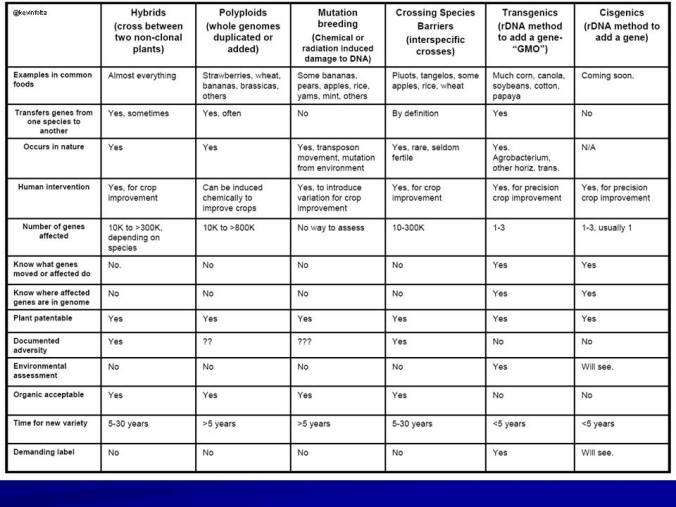
Plant Breeding Chart - courtesy Kevin Folta

Plant Breeding Chart – courtesy Kevin Folta

He described how genes are transferred. It is a straightforward and effective process, not resembling at all the “frankenfood” images often seen on the Internet. And it is tested and safe. In 18 years, not one case of illness or death has been related to GMOs.

While the technology may be relatively new, he reminded us that humans have been manipulating plant genetics for more than 10,000 years. As the world’s population increases, moving forward in developing genetics and production methods will generate better quality and increased yields on the same land-base with fewer inputs. Resistance is one limitation, but this can be overcome.

Many consumers want “natural” food, but Folta advised that nothing we eat is natural. It has all changed from its original form.
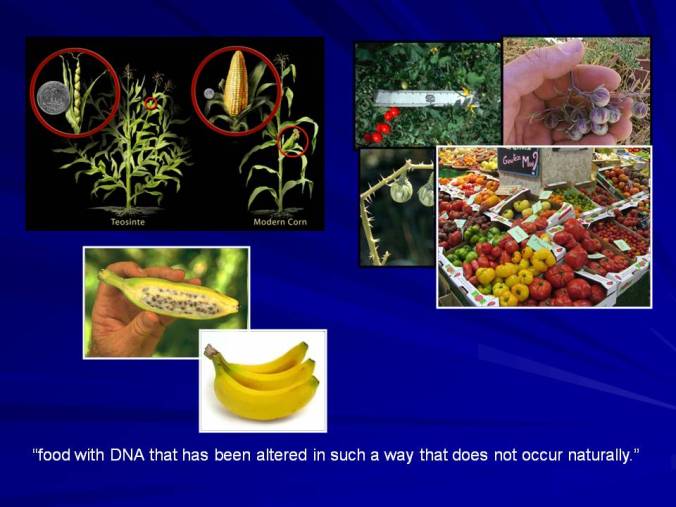
Courtesy Kevin Folta

Courtesy Kevin Folta

The public is hungry for knowledge, but torn as to who to believe. Fear and risk are being manufactured and sold by so-called experts, he says. Correlation, not causation is being cited. Biotechnology is only part of the solution in feeding our growing world, but it shouldn’t be opposed for invalid reasons.

The most sobering part of his presentation was learning of available solutions being blocked because of misinformation, fear and activism.

Strawberries could be grown without fungicides by allowing a single gene within the strawberry to be “turned up” all the way, he says. Biotech “golden” rice, rich in Vitamin A, could prevent blindness and death. Root disease could be stopped in cassava, a nutrient rich root vegetable. Drought-resistant corn could be grown. The allergy gene in peanuts could be “turned off”. Black spot and wilt could be prevented in tomatoes. Oil content and quality improvements could be made in soybeans and canola. Diseases could be stopped in grapes, eggplant and citrus crops.

While this technology sits on a shelf, the benefits to farmers, consumers and the environment are being delayed. Most striking are solutions to drought, famine and disease in developing nations not being implemented because of activism from first world countries where food is abundant, plentiful, affordable and safe.

As a farmer, I believe if all concerned consumers had the benefit of attending this informative event, the debate over how our food is produced would stop. The evening was invaluable as a resource for advocacy. If we and others in the industry are able to share our stories and answer questions, perhaps we can help advance science and reason to ensure productive steps continue to taken to improve agriculture methods and food production around the world.


More information on GMOs can be found via the links below.

GMO Answers

Talking Biotech Podcast

Biofortified Blog

Genetic Literacy Project